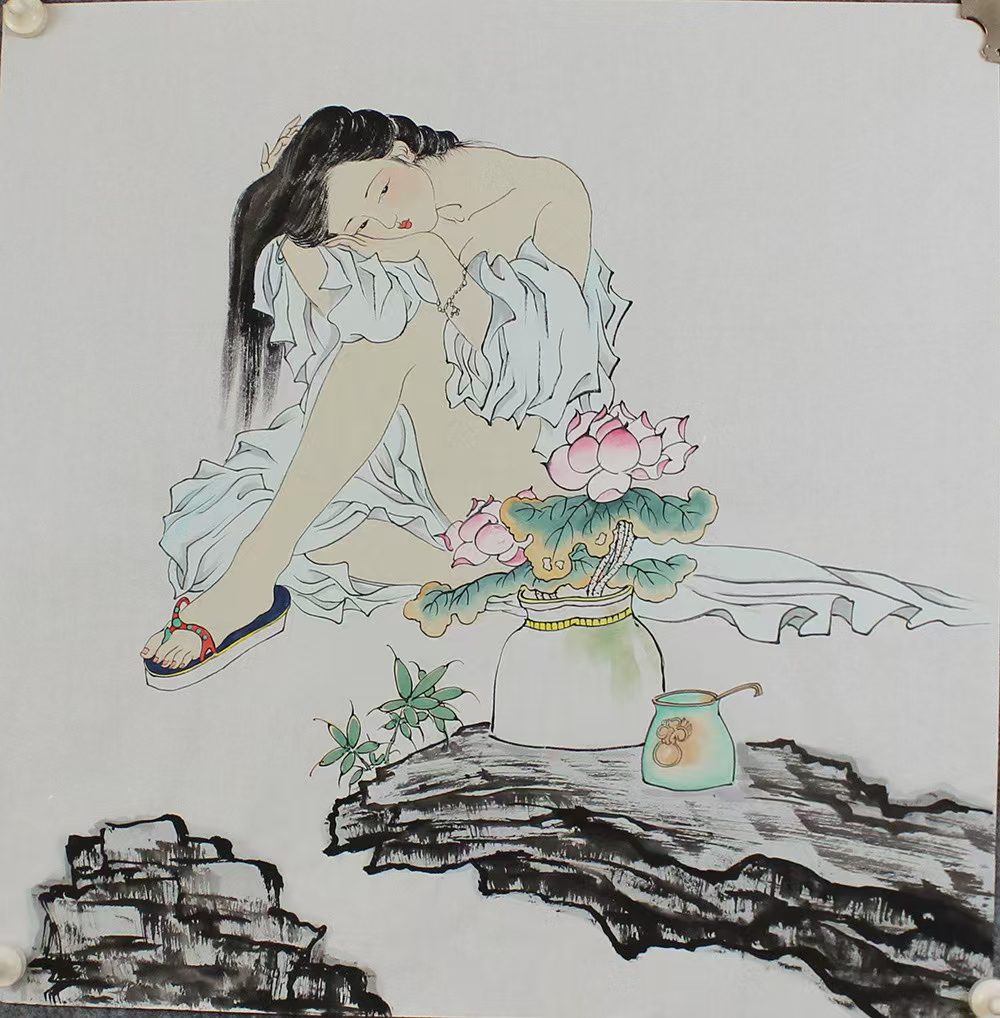
Modern Chinese painting stands for a lively and dynamic development of imaginative expression that delicately mixes traditional methods with contemporary styles and styles. As a diverse style, it shows the socio-political modifications and cultural improvements taking place in China over the past century and past. The origins of modern Chinese painting can be traced back to the late Qing Dynasty, however it gained significant grip and international recognition throughout the 20th century, particularly after the facility of the People’s Republic of China in 1949. This duration saw an interesting interplay between Western impacts and indigenous creative customs, resulting in a rich tapestry of works that test the borders of standard painting.
One can not talk about modern Chinese painting without acknowledging the impact of the Chinese literati, or scholar-officials, that traditionally held an adored setting within Chinese society. Their emphasis on individual expression, literary allusions, and the quest of creative integrity laid the groundwork for the modern musicians browsing the facility landscape of contemporary society.
The development of modern Chinese painting can additionally be related to the intro of Western art activities in the late 19th and very early 20th centuries. Artists like Xu Beihong championed the assimilation of Western techniques, such as oil painting, right into traditional Chinese techniques. He advocated for a hybrid design that maintained the essence of Chinese visual appeals while embracing the realistic look and viewpoint offered by the Western canon. Such testing marked the beginning of an era where the lines between conventional Chinese painting and contemporary methods ended up being significantly blurred, promoting an environment of creative thinking and innovation.
The Cultural Revolution (1966-1976) produced significant turmoil and suppression in the art globe, as the Chinese Communist Party sought to control social expressions that did not straighten with its ideological framework. Throughout this duration, many musicians dealt with censorship and mistreatment, which paradoxically laid the groundwork for a new age of creative defiance in the post-Mao age. With the opening of China in the late 1970s and the subsequent economic reforms, musicians started to redeem their voices and discover a varied array of styles, leading to the emergence of contemporary activities such as the ‘Stars Art Group.’ This cumulative, consisting of artists who openly slammed government constraints, became a system for extreme self-expression and experimentation. Their vibrant strategy urged arising artists to discover unconventional themes, materials, and strategies, additionally pressing the boundaries of modern Chinese painting.
One significant facet of modern Chinese painting is its ingrained link to socio-political commentary. Ai Weiwei, known for his intriguing installments and conceptual artwork, blends traditional Chinese aesthetics with modern methods to attend to themes of liberty of expression and governmental authority.
The surge of woman artists in modern Chinese painting has actually also played a crucial duty in expanding the artistic story. Artists like Liu Xiaodong and Yin Xiuzhen have actually discovered sex, identification, and social expectations through their jobs, offering fresh point of views that test the predominantly male-dominated art world. Liu Xiaodong, renowned for his ability to capture the human condition with portrait, commonly depicts people from marginalized neighborhoods, highlighting the detailed tapestry of modern life in China. On the various other hand, Yin Xiuzhen employs multimedias and installations to check out styles of globalization, consumerism, and the setting, showcasing the intersection of traditional Contemporary issues and chinese worths. Their payments have enriched the landscape of modern Chinese painting, fostering an environment where diverse voices can be listened to and appreciated.
The international art market has actually progressively identified modern Chinese painting, with public auction houses and galleries taking note of its increasing prestige. The worldwide stage has offered chances for Chinese musicians to showcase their work beyond nationwide borders, transforming the way art from China is viewed and valued.
Regardless of these difficulties, modern Chinese painting proceeds to grow, driven by a new generation of artists who are unafraid to press borders and difficulty conventions. The combination of electronic art, video installations, and efficiency art mirrors the fluidity of modern Chinese identity, matching the quick rate of social modification and the intricacies of modern existence.
As we delve much deeper right into the world of modern Chinese painting, it becomes apparent that it is a representation of both personal and cumulative experiences. Musicians face styles of memory, link, loss, and durability, weaving their stories into the fabric of their work. The exploration of identity in a nation that has actually undergone extensive improvement invites customers to engage with the complexities of selfhood within a quickly transforming cultural landscape. Modern Chinese painting acts as a mirror reflecting the stories of its individuals, catching the contradictions, ambitions, and wonders of modern culture.
The continuing discussion between practice and modernity remains a specifying function of modern Chinese painting. While the expedition of brand-new techniques and designs is extremely important, many musicians stay rooted in classic practices, guaranteeing that the significance of Chinese cultural heritage continues in their work.
Imaginative residency programs and cultural exchanges better foster cooperation among musicians both within China and abroad. Such efforts not just advertise cross-cultural dialogue yet likewise encourage experimental discussions that go beyond geographical boundaries. As musicians share concepts and experiences, they develop new stories enriched by varied point of views, permitting modern Chinese painting to develop continually. This collaborative spirit promotes a broader understanding of modern Chinese art as an interconnected global discourse instead of a particular, isolated phenomenon.
Eventually, modern Chinese painting is defined by its capability to encapsulate a broad variety of psychological and intellectual feedbacks to modern life. Hence, modern Chinese painting stands not simply as a testament to imaginative testing but as a vital social dialogue that bridges the past, existing, and future, making certain that the tales of its individuals proceed to resonate and motivate.
Discover Modern Chinese Painting the vibrant advancement of modern Chinese painting, where typical strategies satisfy modern styles, showing collective and personal narratives formed by history, national politics, and social identity.